I started searching through the web and looking for repositories that I can contribute to. I first looked through the well-known repositories, like tensorflow, p5js and so on.
For my project, I decided to contribute to translation of MDN Web Docs.
MDN Web Docs is an open-source, collaborative project that documents web technologies including CSS, HTML, JavaScript, and Web APIs. Alongside detailed reference documentation, we provide extensive learning resources for students and beginners getting started with web development.
MDN’s mission is to provide a blueprint for a better internet and empower a new generation of developers and content creators to build it.
The strength of MDN Web Docs lies in its vast community of active readers and contributors. Since 2005, approximately 45,000 contributors have created the documentation we know and love. Together, contributors have created over 45,000 documents that make up an up-to-date, comprehensive, and free resource for web developers worldwide.
In addition to English-language articles, over 35 volunteers lead translation and localization efforts for Chinese, French, Japanese, Korean, Portuguese, Russian, and Spanish.
The Mozilla Developer Network (MDN) content is licensed under open-source licenses, allowing users to freely use, modify, and share its materials. All prose content on MDN, such as written explanations and documentation, is available under the Creative Commons Attribution-ShareAlike 2.5 (CC-BY-SA 2.5) license. This license allows anyone to copy, modify, and distribute the content, even commercially, as long as they credit the original author and license any derivative works under the same terms. Users must also retain copyright notices and licensing terms when redistributing the work, and they cannot impose additional restrictions beyond those in the license.
For code examples and snippets, licensing depends on when they were added. Code added after August 20, 2010, is dedicated to the public domain using the CC0 license, meaning it can be used without any restrictions or the need for attribution. Code added before that date is licensed under the permissive MIT license, which allows free use, modification, and distribution, provided the original license notice is included. All licenses emphasize the content is provided “as-is,” without warranties, and the licensors disclaim liability for any resulting damages.
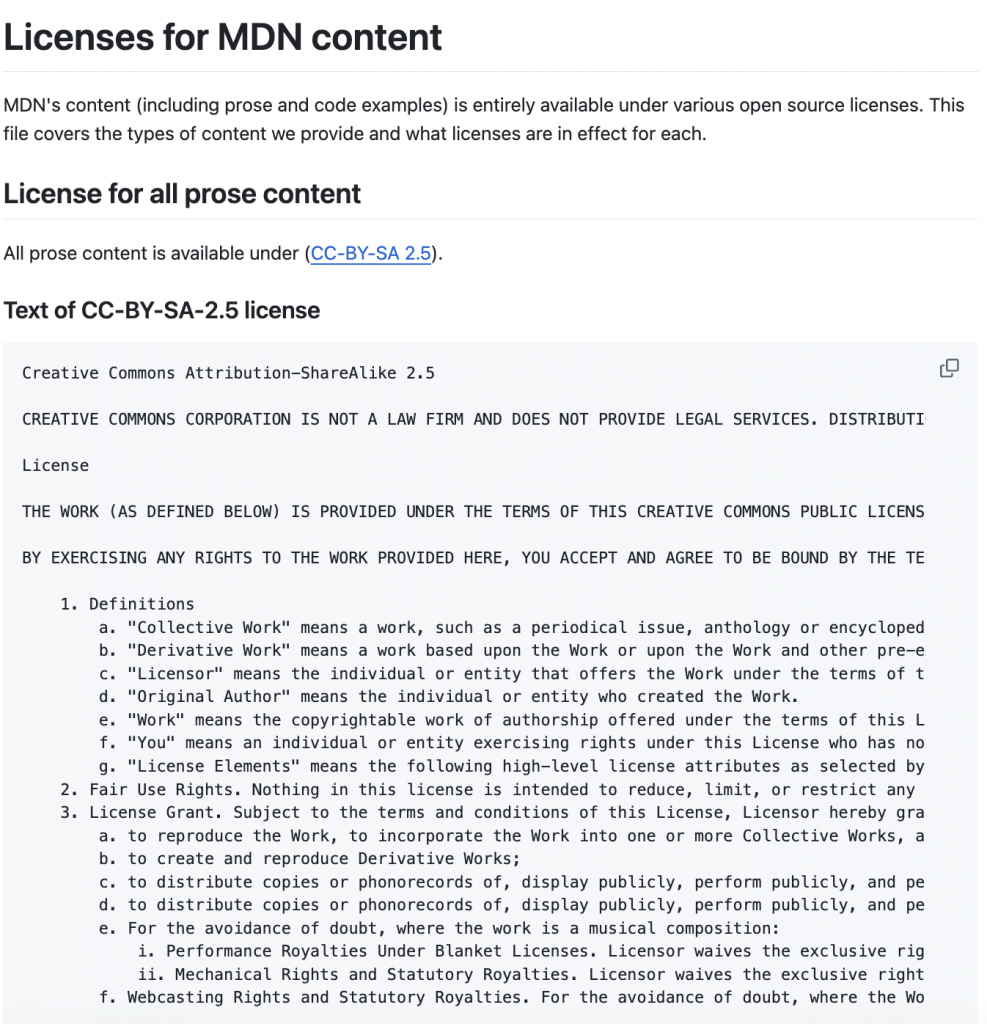
During my second‐year Web Development module, I relied heavily on MDN Web Docs for all my front-end projects—its clear, example-driven articles were invaluable in helping me learn. Now I’d like to give back to the same resource that taught me by contributing translations (or documentation improvements), so other students can benefit just as I did.
The main repository in english is here.
There is a separate translated-content repository that contains all the translated languages. After finding this repository, I looked into issues related to Russian translation. I found an issue that contains a list of all untranslated files.
I sent a request on 12th of March to translate one of the pages. The translation of the message can be found below.
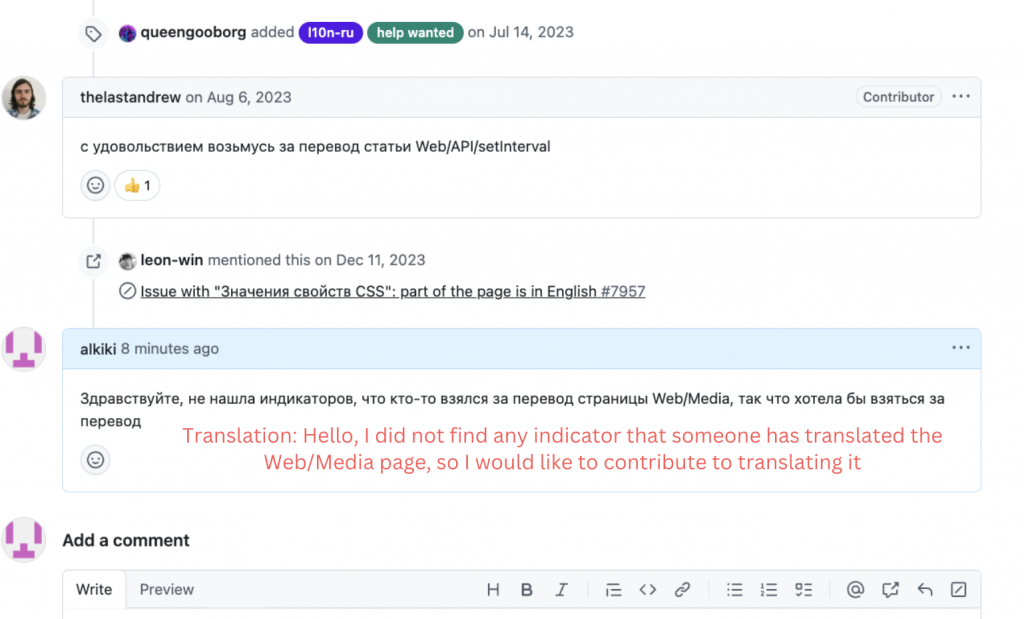
I picked the Web Media overview page (/docs/Web/Media) for translation because:
- High impact & traffic: It’s the gateway to all of MDN’s audio-, video-, and streaming-related content—one of the most frequently visited sections by front-end developers who need to embed or control media.
- Foundational importance: Media APIs (HTMLMediaElement, Web Audio, Media Streams, etc.) are core to modern web apps—from video players to WebRTC—so having this high-level roadmap in Russian helps countless learners orient themselves before diving into individual guides.
- Personal relevance: In my own second-year projects, I repeatedly referred back to this summary page to find the right API links and usage patterns. Translating it was a natural first step to give back a resource I myself leaned on heavily.
Leave a Reply